
Kāinga Ora: you can’t have it both ways
Recently I’ve noticed a trend, where the government scraps accessibility targets, then claims it will have no impact. I don’t buy it.
Kāinga Ora scraps accessibility targets
Kāinga Ora is our government agency that develops public housing.
In 2019, they set an Accessibility Policy that required the agency to ensure at least 15% of its new homes meet “universal design standards”.
Universal design standards are requirements that help to make buildings accessible for disabled people, and older people.
Kāinga Ora committed to formally reporting its progress in accountability documents like its annual report.
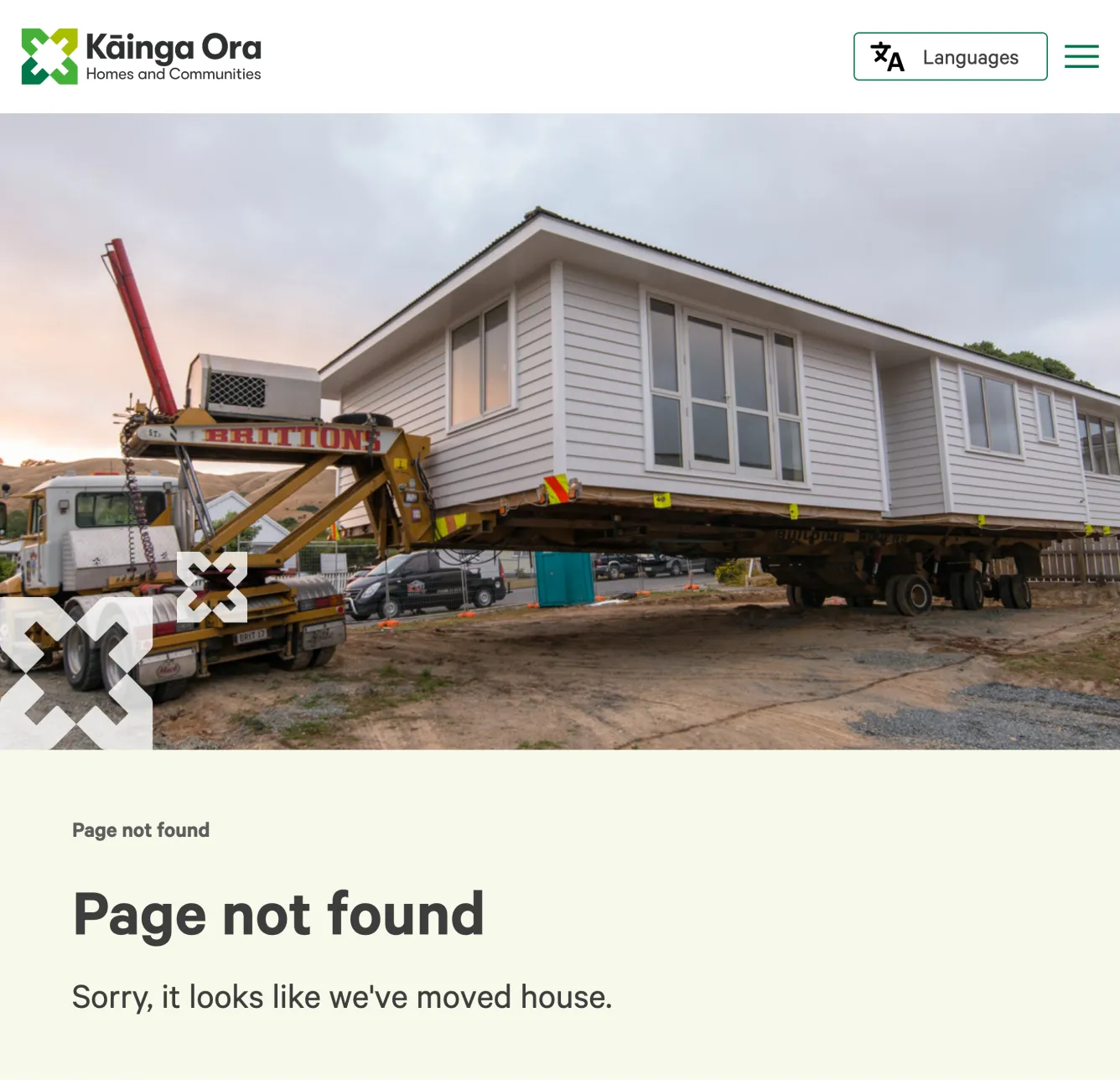
But what happens if we try to view the policy on Kāinga Ora’s website?
Well… it’s been scrubbed from existence.
Scrutiny Week 2026
Being the sad political creature I am, I watched the 17 June 2026 Social Services and Community Committee hearing as part of Scrutiny Week 2026. The relevant part starts at about the 39 minute point.
What I heard in this hearing was rather disturbing.
I’m going to give you some context, by showing how Chris Bishop, the Minister for Housing, clearly does understand the importance of accessible social housing for disabled people.
Tamatha Paul questions Chris Bishop (Minister for Housing)
Tamatha Paul is the Green Party’s housing spokesperson.
Is that the only modelling you’ve done in terms of public housing tenants being able to move into the private market, or have you considered things like a lot of people in public housing are disabled and only 2% of the housing stock […] is accessible? And that, they might not be able to live in houses in the private rental market?
Did you think about discrimination that people face when they try to get a private rental? What else did you factor in, in addition to affordability?
Tamatha Paul
Bishop responds.
Well, that’s the whole point.
At the moment, the social assessment criteria […] is heavily weighted towards affordability, which is important.
Much less of a focus is […] access barriers, so disabilities, discrimination in the private rental market. Those things are important.
Chris Bishop
He continues:
If you said to most people, “Who is social housing for?” Most people would say, “Oh, it’s for people with disabilities. It’s for people who face barriers in accessing private housing as well as affordability challenges.”
Chris Bishop
So, this actually sounds like a very good response from Bishop. He clearly understands the social obligations of the State, and he appears to clearly articulate that social housing’s focus should be on, for instance, disabled people, as the private market intensely discriminates against this population group. 5 stars for Bishop here.
Then it goes tits up.
Tamatha Paul raises the removal of the 15% universal design target
4% of Kāinga Ora stock is accessible.
Why did you guys get rid of the target this year for building accessible homes?
Tamatha Paul
Then Bishop crumbles.
Well, the Board got rid of the um… part of it.
Tracey, yep do you want to talk about the accessibility stuff?
Um, well it’s just to reduce, umm…
Well I’ll let Tracey talk to it.
Chris Bishop
Funny. Bishop says social housing is obviously for disabled people. Then freezes up when Tamatha Paul asks why the accessible housing target was removed. Then he deflects the question to Tracey Taylor, the Chief Executive of Kāinga Ora.
Tracey then attempts to respond:
Well, that was one of our SPEs [statement of performance expectations], so a target that we had.
We still build a lot of our homes with accessibility features. So wider halls, lower door handles, those sort of things. So that is still ongoing.
So a good percentage of our homes are accessible. The removal of the target doesn’t mean that we aren’t focusing on accessibility.
Tracey Taylor, Chief Executive of Kāinga Ora
Tracey Taylor continues:
When we do get people with accessibility needs, we think about that […] with our other agencies like ACC, et cetera, what can we do to the home?
So the focus is still there. We just didn’t think that it was one of the key targets that needed to remain within the SPE. But it doesn’t mean that it’s less important and isn’t happening.
Tracey Taylor, Chief Executive of Kāinga Ora
The CE just “didn’t think” the target was necessary. Didn’t think.
Well, I “didn’t think” that was a believable answer.
How is it that government officials claim that accessibility is going well while they strip accessibility targets and standards out of the system?
You can’t have it both ways.
So why did Kāinga Ora remove the target?
Since both the Minister and CE failed to answer Tamatha Paul’s question, I had to dig through the documents to find the real justification for removing accessible housing targets.
Thankfully, Bishop let the mask slip in an earlier story from The Post.
Kāinga Ora dropped its universal design target as it shifted to “prioritising financial sustainability and value for money”.
Kāinga Ora ditches target to make more public homes accessible — The Post
Ah. Right. Because they don’t want to spend money on accessibility. Isn’t it funny how that differs from their statements during the Scrutiny Week hearing. Isn’t that odd.
I searched dozens of Kāinga Ora’s published OIA responses and found the unsettling justification for the target removal:
Building to FUD standard increases the typical build cost of a home. In early 2025, Kāinga Ora made a commitment to improving our financial sustainability and refocusing on our core mission of providing and managing state-owned social housing in a financially sustainable way.
This narrower focus means Kāinga Ora will build less new homes and from this financial year 2025/26, no longer has a Statement of Performance Expectations target for the delivery of FUD homes. Kāinga Ora will continue to deliver FUD homes when the location, typology and build costs allow.
OIA response, 4 August 2025, Kāinga Ora
But, are universally designed homes actually more expensive?
Okay, so we have the Minister and Kāinga Ora both saying it’s too expensive for them to build accessible homes, so they scrapped the target.
Something that is resoundingly absent, is any actual proof of the claim that FUD (Full Universal Design) homes are actually more expensive. Everyone just seems to make this assertion without any evidence.
This is where it’s tempting for me to apply Hitchens’s Razor: What can be asserted without evidence can also be dismissed without evidence.
Anyway, let’s look at the facts. Is universal design really more expensive?
Kāinga Ora’s own documents contradict the cost argument:
Can Kāinga Ora afford universal design? Yes. Quite apart from the moral and human rights imperatives, it is actually better value to use universal design than to omit it.
The Government’s own Building Performance website claims there’s a 60% chance that someone with a permanent disability will live in a given home during its expected 80-year lifetime.
Remember how Kāinga Ora’s Accessibility Policy got scrubbed from their website? Well I took a trip through the Wayback Machine to resurrect it from the digital graveyard. The Accessibility Policy itself admits that retrofitting accessibility is far more expensive than building accessible housing from the start:
Including universal design […] in new builds is likely to be the most cost-effective way for us to increase the number of accessible properties
All the research confirms that incorporating accessibility features retrospectively is always more expensive than incorporating accessibility into new builds
Why on earth do we spend public funds on houses that end up needing significant modifications to meet the needs of the humans who require them? It’s nonsense.
So, clearly the math isn’t stacking up here. The Government’s own assertions on the costs of accessible housing are contradictory: it can’t be “more expensive” and also “much cheaper” at the same time.
You can’t have it both ways.
Conclusion
I think it’s fairly clear what’s going on here.
New Zealand’s largest landlord has decided it doesn’t care about accessibility.
If it cared, it’d have a target.
It calls it “too expensive” so scraps it.
While this might save a few dollars in the short-term, the long-term costs will be substantially higher:
- retrofits are slow and far more expensive overall
- disabled people will be homeless
- disabled people will be stuck in non-accessible houses
- huge social costs will occur as a result.
I want to draw attention to the bureaucratic magic trick they’re using here: they eliminate the accessibility policy, the targets, the accountability system, while fronting up to Parliament saying “don’t worry, accessibility is still happening!”
I don’t think the disabled community is so easily fooled.
There is a huge amount of cognitive dissonance and doublespeak going on in this situation. Everyone in the room appears to agree that accessibility is important, while they destroy the very mechanisms that make accessibility happen.
You can’t have it both ways.
— Callum