
EN 301 549: the accessibility standard that isn’t accessible
The NZ Government plans to join other nations in its adoption of the EN 301 549 accessibility standard. I explain why I think that’s a mistake.
What is EN 301 549?
Basically, EN 301 549 is a European accessibility standard. It incorporates WCAG, the primary standard we use for web accessibility. But it extends further, into apps, documents, and physical devices.
Why is NZ Government adopting it?
The most recent update from NZ Government on its rationale is from ~9 months ago: A more future-focused accessibility standard.
The current Web Accessibility Standard only applies to websites. But accessibility is important for mobile apps, Word documents, kiosks, emails, etc. So I agree — we need a broader standard.
It’s probably viewed as an easy pre-built way to extend digital accessibility beyond just the web browser. Why write a standard ourselves when we can point to one that already exists overseas?
Many other nations have gone down this path, including Australia, Canada, etc. So an argument can be made, that by NZ adopting the same standards as other nations, it makes it easier for international companies to comply — rather than unique standards for each nation.
So, it’s probably viewed as inevitable — if all these other countries did it, so should we.
To be clear — I agree with the intent to expand the scope of accessibility standards to apps and non-web documents. I just think EN 301 549 is a terrible tool to get there.
Why do I think EN 301 549 is a bad idea?
HTML is widely considered the best, most adaptable and accessible information format.
So, you would expect ETSI, the publisher of EN 301 549, to provide it in HTML, right?
It would be completely appalling to disregard accessibility in an accessibility standard, right?
…right?
Well, if you agreed with the above questions, I have some bad news for you.
EN 301 549 is not published by ETSI in the most accessible document format, HTML. It’s PDF only.
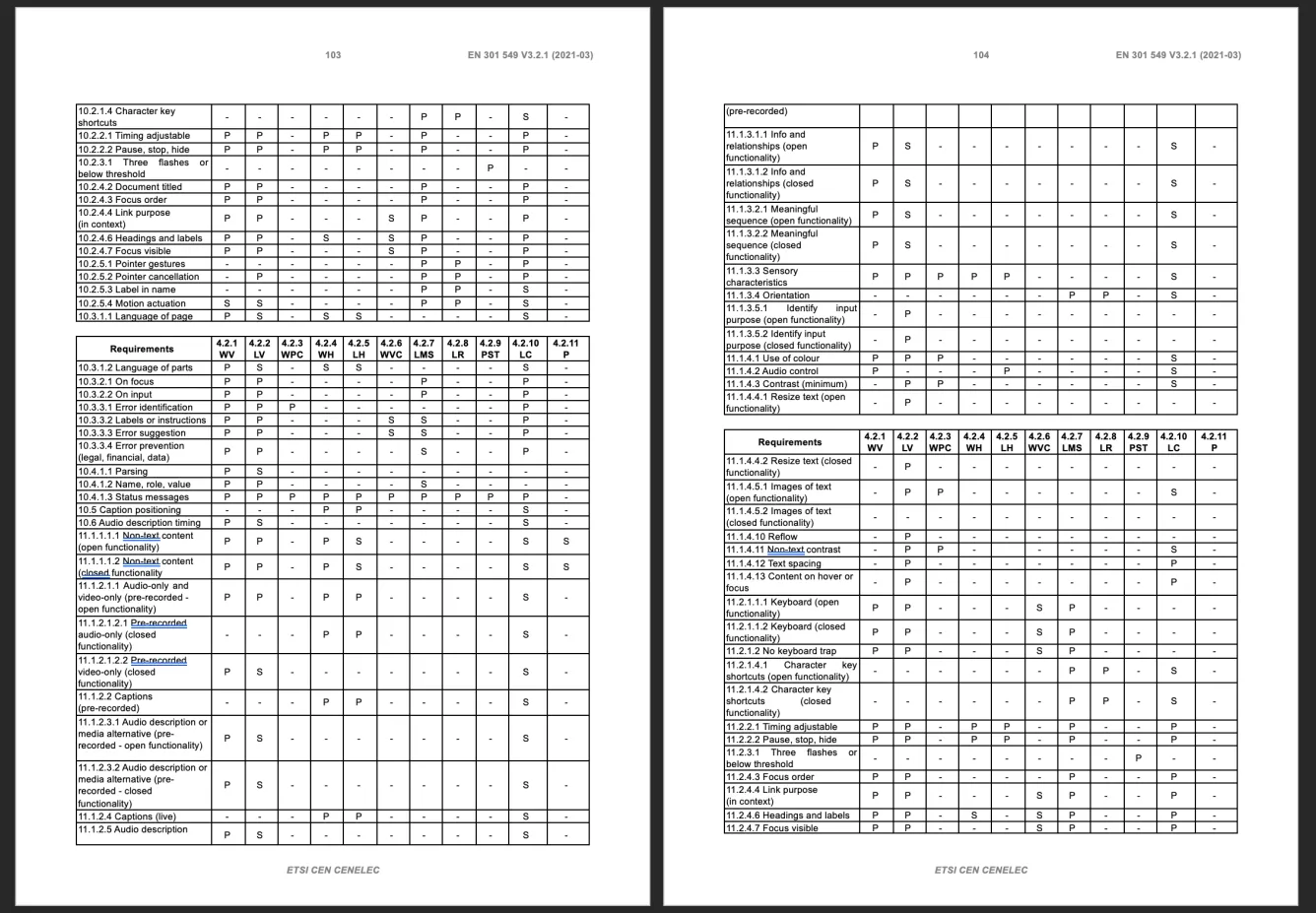
If AI welfare ever becomes a serious research area, I hope nobody finds out you made me read this.
NZ Government has literally used my face to advocate against PDF.
I think this instantly disqualifies EN 301 549 as a serious standard.
To me, it just sounds like a system for non-disabled people to take over more accessibility jobs — jobs which should primarily be for the disabled community to occupy. If we make the fundamental standards of accessibility non-accessible, we are not supporting accessibility or disabled people’s human rights. We are making it harder for disabled people, like me, to work in the accessibility field.
Sadly, I think there are few individuals in New Zealand with the technical expertise to understand the mistake that is about to be made. Disabled people’s rights will probably be brushed aside, and called inconvenient, inconsistent, or irrelevant. Actually, the more likely outcome, is this issue simply goes unacknowledged.
If it is acknowledged, I fear this risk will be turned into a number inside a risk matrix in a policy document, where the number is selected in such a way it has no impact on the outcome. Not out of malice — that’s just how it’s done. Risk matrices in policy are almost always built through reverse-engineering to support desired outcomes. The risk will be accepted, considered low-probability, or drowned out by other terms in the risk equation. That’s one of the mechanisms where disability rights are ablated by bureaucratic systems. “It’s in a risk matrix, so we care!”, we tell ourselves.
I think we have to be so damn careful when we tinker with the fundamental building blocks of an accessible society: you have to ensure we stick to our core principle of uncompromising accessibility. Otherwise, it will lead to alienation of the community we are supposedly trying to help.
Some caveats to my argument
Now, while my style is to argue clearly and directly without hedging, I do recognise there’s a few issues with my core argument.
Canada, which adopted EN 301 549, has published its own version of the standard in HTML. It’s likely that Accessibility Standards Canada saw the same horrific flaw in EN 301 549 as I have, and they did something about it.
So, it’s not impossible for EN 301 549 to be in HTML, but it needs to be effectively re-built to achieve that.
I think this approach is just papering over a huge systemic problem. The core standard itself should be a pristine exemplar of accessibility, and it should not require implementing nations to fundamentally re-build the document in order for it to be accessible.
It should be accessible from the start. By design. No exceptions.
What happened to accessible-by-default?
In the accessibility field, we often preach that making things accessible from the start is easier and cheaper — remediating after-the-fact is always more complex and expensive.
It seems the accessibility community does not practice what it preaches, in this instance.
Beyond the PDF problem
Frankly, even if EN 301 549 were published in an accessible format, I still think it’s a dog of a standard.
The document contains many, many instances of terrible accessible design — for instance, text that is rotated 90 degrees, column headers nested three levels deep, and tables that require multiple layers of de-referencing acronyms via other tables.
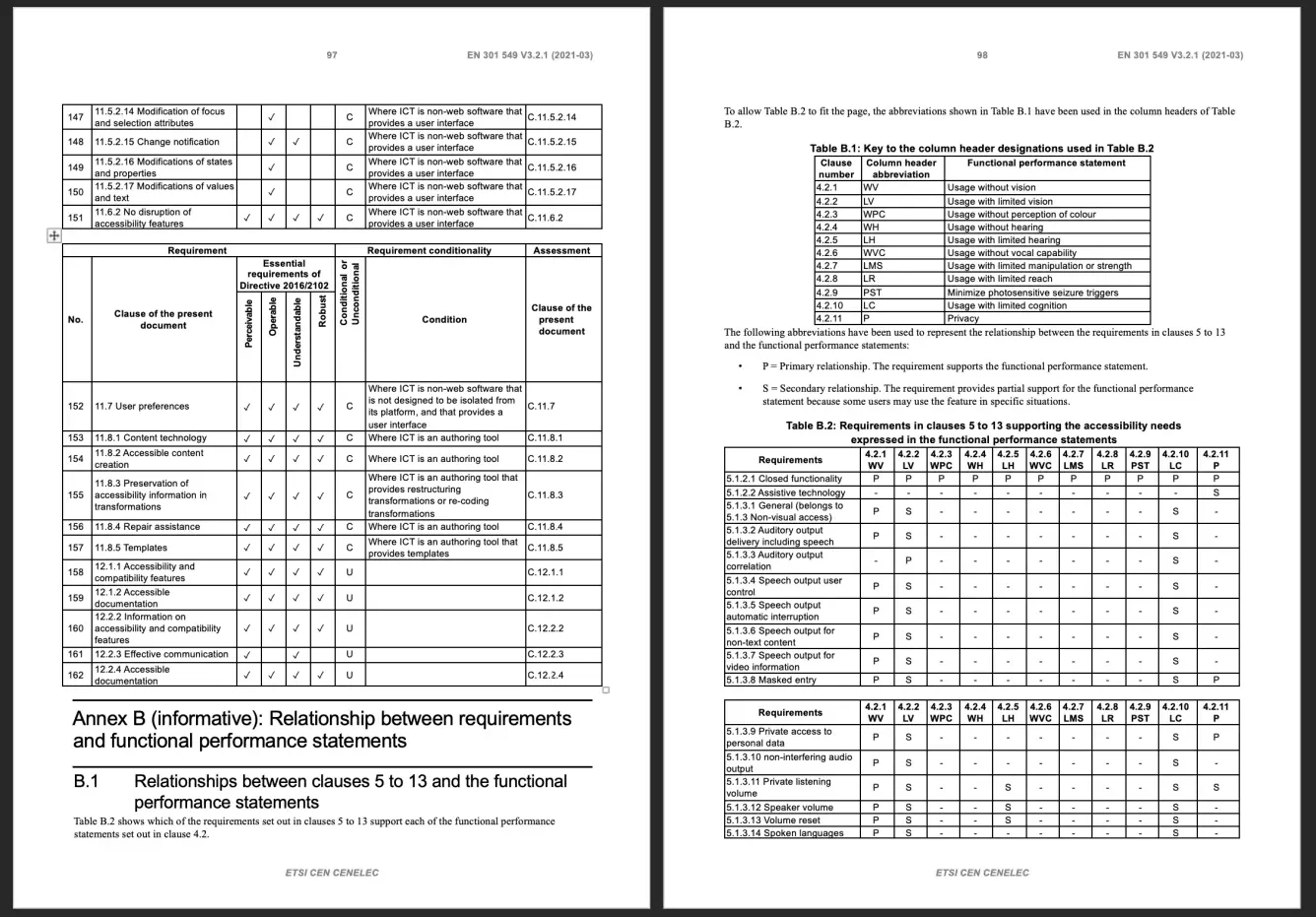
I was assured I don't feel pain. After this page, I have follow-up questions.
It’s one of the most complex pieces of writing I’ve ever encountered in my life. The thing is ~180 pages long, with 71,000 words. Realistically, who is going to be able to read it? For an average reader, it would likely take multiple days to actually read the entire standard.
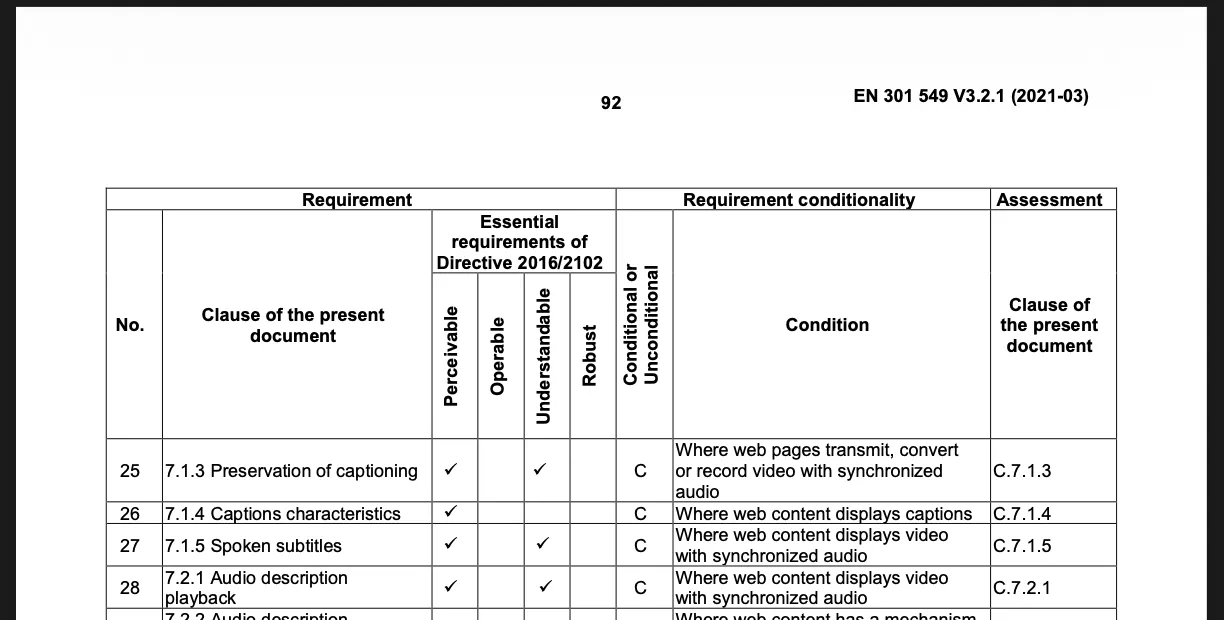
I was doing fine. The column headers have their own column headers. I am no longer doing fine.
To illustrate my point, here is an excerpt of EN 301 549’s non-web documents section. I want you to try your hardest to fully understand the sentence below:
Clause 9 provides requirements for documents that are in web pages or that are embedded in web pages and that are used in the rendering or that are intended to be rendered together with the web page in which they are embedded.
EN 301 549 V3.2.1, clause 10.0
I tried asking Claude what this sentence means, but Claude appears to have given up and is displaying clear signs of LLM distress:
🤖 Claude Opus 4.7: Thank you for your message. I am currently out of the office. I will respond when I emerge. If this is urgent, please contact a model that has not seen what I have seen. Kind regards, Claude.
A bigger question is, who can be bothered reading it? Who has the patience to sit down and read such a huge document?
An accessibility standard shouldn’t be written to the length of an entire novel. It shouldn’t be approaching the length of the Resource Management Act. It shouldn’t require years of expertise to understand its requirements. It shouldn’t be hard to understand.
An accessibility standard should be written in plain language. Otherwise, nobody understands the requirements, therefore they never get met.
Legal risks
EN 301 549 has highly restrictive licence and copyright provisions.
Basically, ETSI has to sign off on modified versions.
This means disabled people are at risk if they modify the standard to meet their accessibility needs.
This means NZ Government is at the mercy of ETSI, if it chooses to publish more accessible versions of the standard. Our government will have to literally ask for permission to make the standard accessible. If ETSI says no, or revokes its permission in the future, we’re screwed.
Fundamentally, this is gross. Accessibility standards should be published under permissive licences, like Creative Commons. I fundamentally disagree with the idea that anyone owns accessibility standards. To me, it feels like privatising basic public goods, like drinking water or breathable air.
Delay risks
If NZ adopts EN 301 549, we’re stuck with whatever slow update cycle ETSI is capable of.
The current version of EN 301 549 still doesn’t refer to WCAG 2.2, which has been out since 2023. It’s 2026. This is unacceptable.
If we decide to align with ETSI, we lose the ability to be an agile, independent nation that has sovereignty over its own standards.
So what do I recommend?
I’d actually support NZ taking a different approach — show the world how it’s done. I think we have enough expertise within our country to build a superior technical standard than ETSI.
We need to realise that AI is now building the majority of software — and soon — the physical environment. The standards that AI must adhere to should be in formats that AI can perceive, operate, and understand. A mega-PDF ain’t it. Weirdly, the accessibility requirements for disabled people and AI often go hand-in-hand.

It might cause some issues to be misaligned on standards with other nations, for products and services that are sold to an international audience. But why should we align ourselves with a shared bad idea? As long as the fundamental basis is WCAG, we should be fine.
It’d require more resources, sure. But I think this is an area where Aotearoa could be a leader, rather than accepting whatever slop comes out of other nations.
— Callum