
2026: Accessibility in review
Let’s explore New Zealand’s changes in accessibility in 2026
Ch-ch-ch-ch-changes
Sometimes it can be hard to tell whether society is getting better or worse for disabled people — so I wanted to write down what I saw as some of the more significant developments in accessibility over the past year.
This post will be a mix of accessibility and disability policy in general.
Employment and poverty
This is probably the thing I’m the most angry about. And it’s not actually something that has changed, it’s something that hasn’t changed.
The employment rate for disabled people hasn’t changed in 10 years. Disabled people are still systematically prevented from having jobs.
Many disabled people are on benefits and experience severe poverty. Insecure housing. Toxic and unsuitable living conditions. Can’t afford the GP. Can’t afford to travel. Can’t afford food. Can’t afford to attend events with friends.
The worst part is, rent typically consumes around half of a benefit payment — half goes straight into a landlord’s bank account. It makes you wonder how much of the wealth of landlords is actually created by the welfare system.
I think the vast majority of accessibility barriers that disabled people face are actually the result of, or heavily exacerbated by a lack of money. If you’re a disabled person on a high income, many accessibility barriers simply disappear. If you’re in poverty, you’re screwed.
Let’s take a look at the horrifying data from Stats NZ.
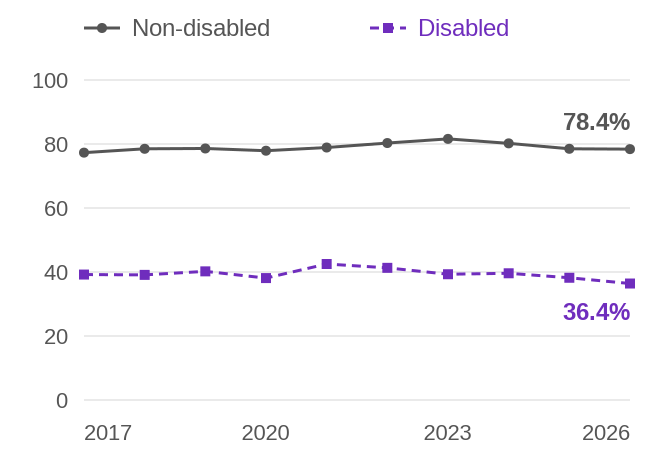
Employment data and source
| Year | Disabled | Non-disabled | Gap |
|---|---|---|---|
| 2017 | 39.2% | 77.3% | 38.1 |
| 2018 | 39.1% | 78.5% | 39.4 |
| 2019 | 40.2% | 78.6% | 38.4 |
| 2020 | 38.1% | 77.9% | 39.8 |
| 2021 | 42.5% | 78.9% | 36.4 |
| 2022 | 41.3% | 80.3% | 39.0 |
| 2023 | 39.3% | 81.6% | 42.3 |
| 2024 | 39.6% | 80.2% | 40.6 |
| 2025 | 38.2% | 78.5% | 40.3 |
| 2026 | 36.4% | 78.4% | 42.0 |
Source: Stats NZ, Household Labour Force Survey, June 2026 disability tables, Table 1a (Excel), published by Whaikaha. The table includes historical figures for 2017–2026. The gap is the difference between the two rates, in percentage points.
These are survey estimates. Whaikaha reports no statistically significant change in disabled people’s headline rates since 2017.
Frankly, I cannot tolerate this data. It’s disgusting. Literally nothing is improving.
The government has clearly been doing nothing to fix this. Or, the things they are doing are so woefully inadequate they have no observable influence on outcomes. Basically, they’re wasting time and achieving nothing.
In 2024/25, MSD allocated $38.9 million across five disability employment initiatives, compared with estimated spending of $2.99 billion on Supported Living Payment and Disability Allowance benefits. That’s about $1.30 spent on supporting disabled people into jobs for every $100 spent on those two benefit types alone — before even counting Jobseeker Support (Health Condition and Disability). The amount spent on disability employment support is completely inadequate.
What is Whaikaha actually doing to shift the dial on employment statistics?
I took a look at Whaikaha’s 2025/26 Annual Report and discovered they dedicated only a single page to the issue in their section on progress against their strategic intentions, where they effectively just spend 3 paragraphs proclaiming how important employment is and describing barriers, then they regurgitate a table of Stats NZ employment data.
It lacks any of the context of my chart above showing how pervasive and unchanging this issue is, and that page describes no actual activities or ways in which Whaikaha is improving outcomes. It’s just sitting there, republishing Stats NZ data claiming it’s a system leader.
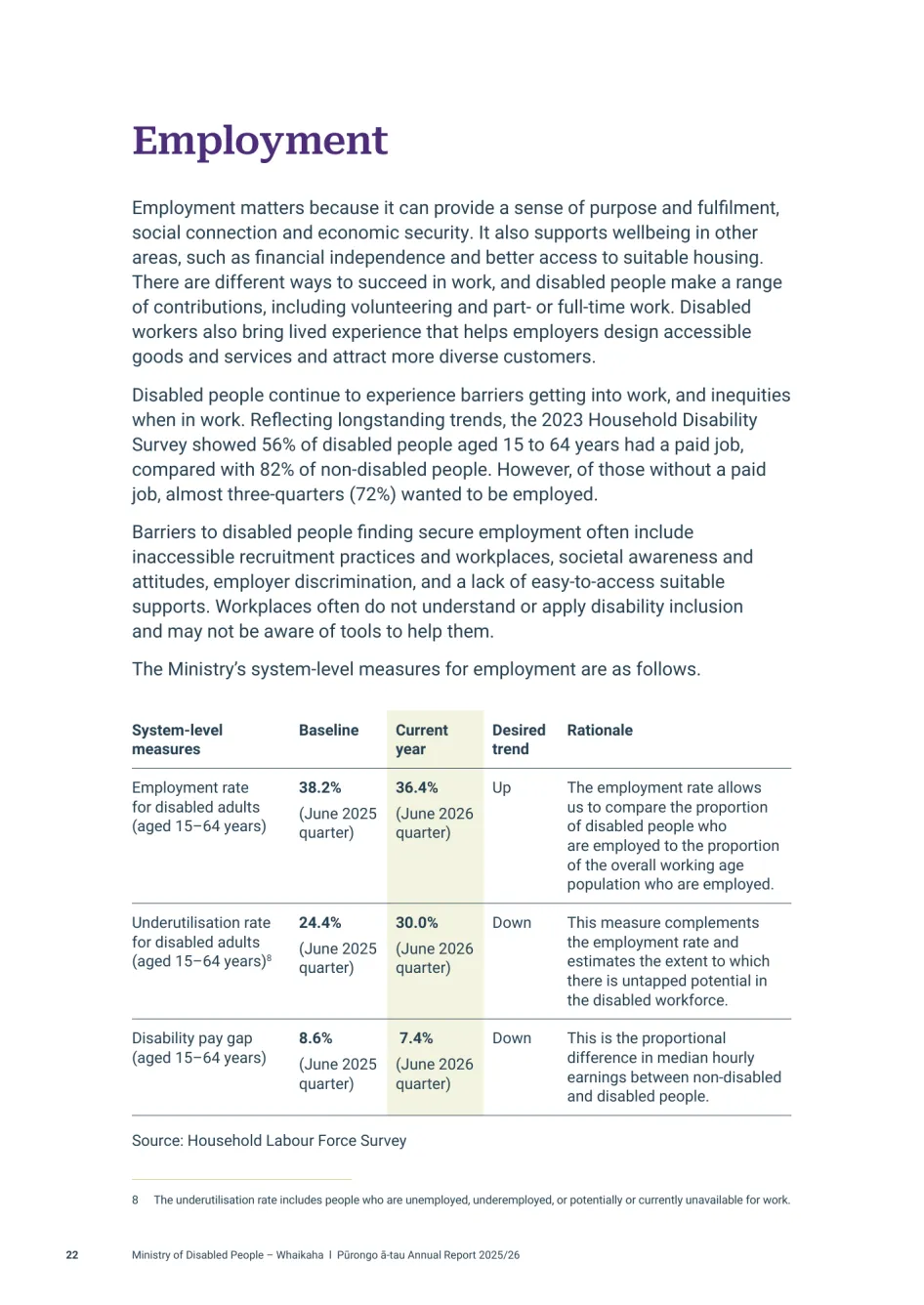
To be fair, page 28 does list employment activities: the “One in Six” disability employment hub, 13 paid internships across 10 government agencies, and a partnership with the New Zealand Disability Employers Network. But listing activities is a long way from showing that the system is changing. I think it is rather unlikely any of these initiatives will cause any measurable change in the overall employment rate of disabled people; they’re caught in the weeds with unmeasurable, unnoticeable policies and programmes.
I have noticed a pattern in social-change activities in government agencies: the first thing they always reach for is to make a “hub” website for whatever issue they’re trying to tackle. I suspect these “hub” sites have very little impact but give the appearance that a government agency is busy and achieving things. A website with information about disability employment is not necessarily a bad thing, but it’s important not to conflate busywork like making a website with actually changing employment outcomes in a measurable way.
Now, linking this back to accessibility. If disabled people are systematically excluded from the labour market, the people building our products and services are far less likely to be disabled, resulting in worse accessibility outcomes in our products/services. A vicious cycle.
A bit more positive: CWAC data is improving
The Centralised Web Accessibility Checker (CWAC) is NZ Govt’s main system for measuring and publicly reporting on accessibility issues in its public websites. It only runs automated tests (primarily axe-core) so it doesn’t catch all issues, but it’s a fairly good indicator.
Taking data from my CWAC Loserboard website, it shows a fairly significant drop in the average number of accessibility issues per page per website across the government.
Between June 2025 and October 2026, the average fell by 39.4%, from 4.14 to 2.51 issues per page.
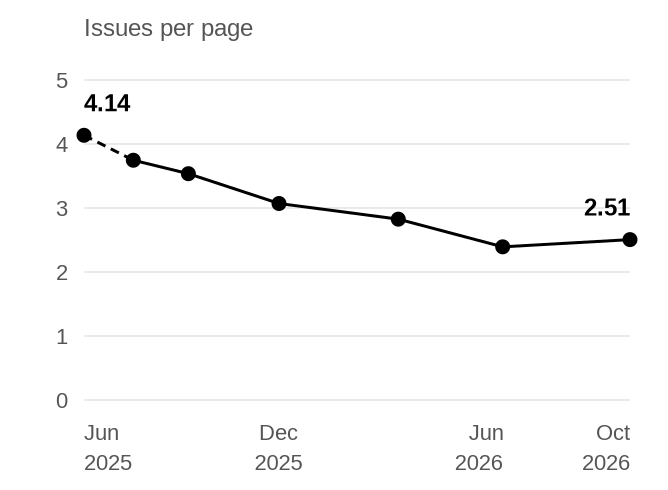
CWAC data and source
| Scan date | Average | Websites | Pages |
|---|---|---|---|
| 30 June 2025 | 4.14 | 454 | 50,491 |
| 12 August 2025 | 3.75 | 501 | 51,825 |
| 29 September 2025 | 3.54 | 489 | 53,175 |
| 17 December 2025 | 3.07 | 481 | 52,231 |
| 31 March 2026 | 2.83 | 497 | 52,445 |
| 30 June 2026 | 2.39 | 489 | 110,301 |
| 19 October 2026 | 2.51 | 487 | 119,676 |
These are the mean issues-per-page scores from the CWAC Loserboard. Each measured website is weighted equally. Websites with no scanned pages are excluded. Figures are rounded to two decimal places.
The June 2025 scan had limited coverage: over 10% of listed websites had no successful page scans. The mix of websites and pages tested changes between scans, so changes in the average do not solely reflect fixes to existing pages. Automated testing covers only part of accessibility.
Source: GDDA’s CWAC monitoring programme, aggregated by CWAC Loserboard. Source data and aggregated figures are licensed under CC BY 4.0.
Let’s hope that trend continues.
Whaikaha is failing to produce accessibility measures…
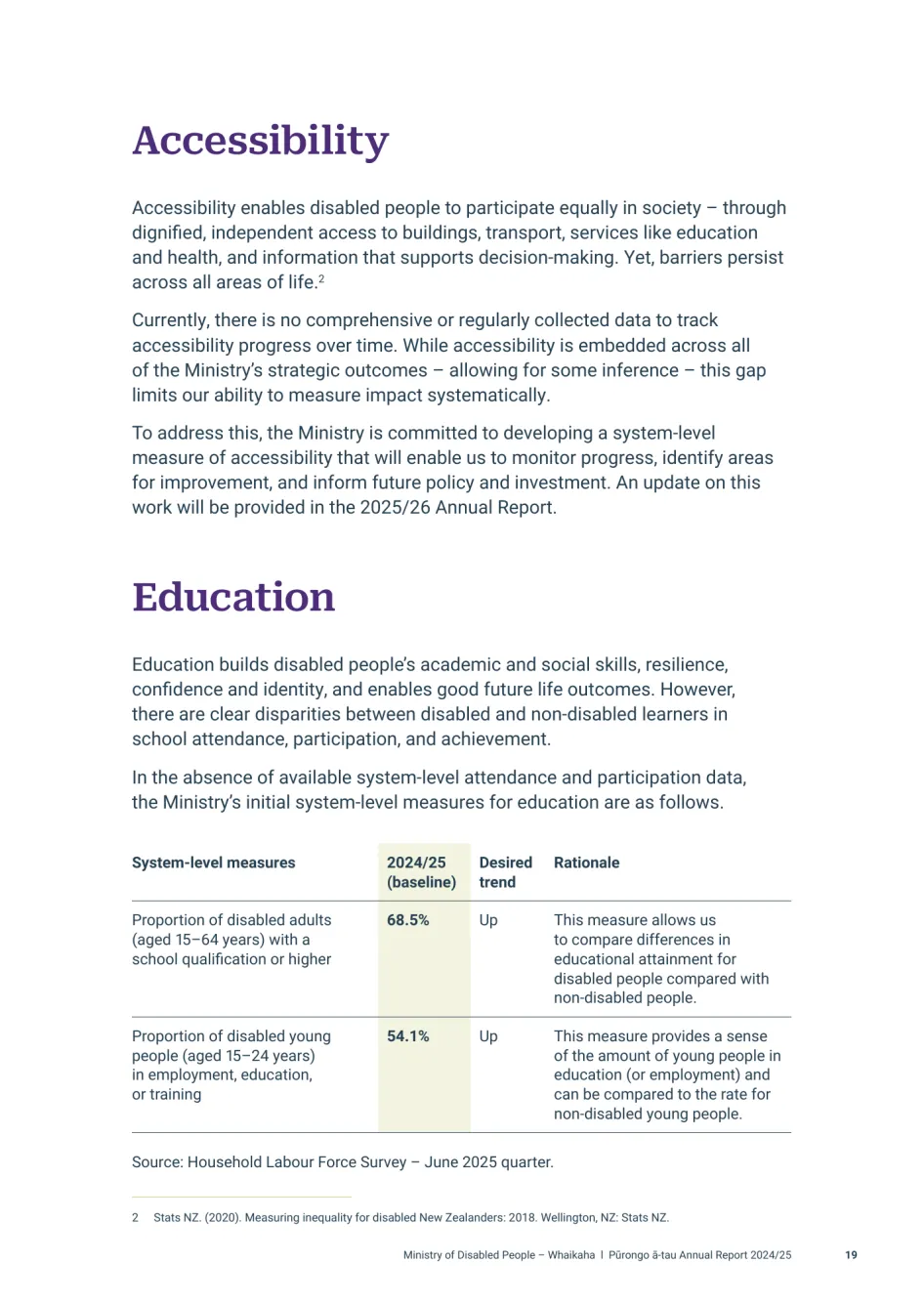
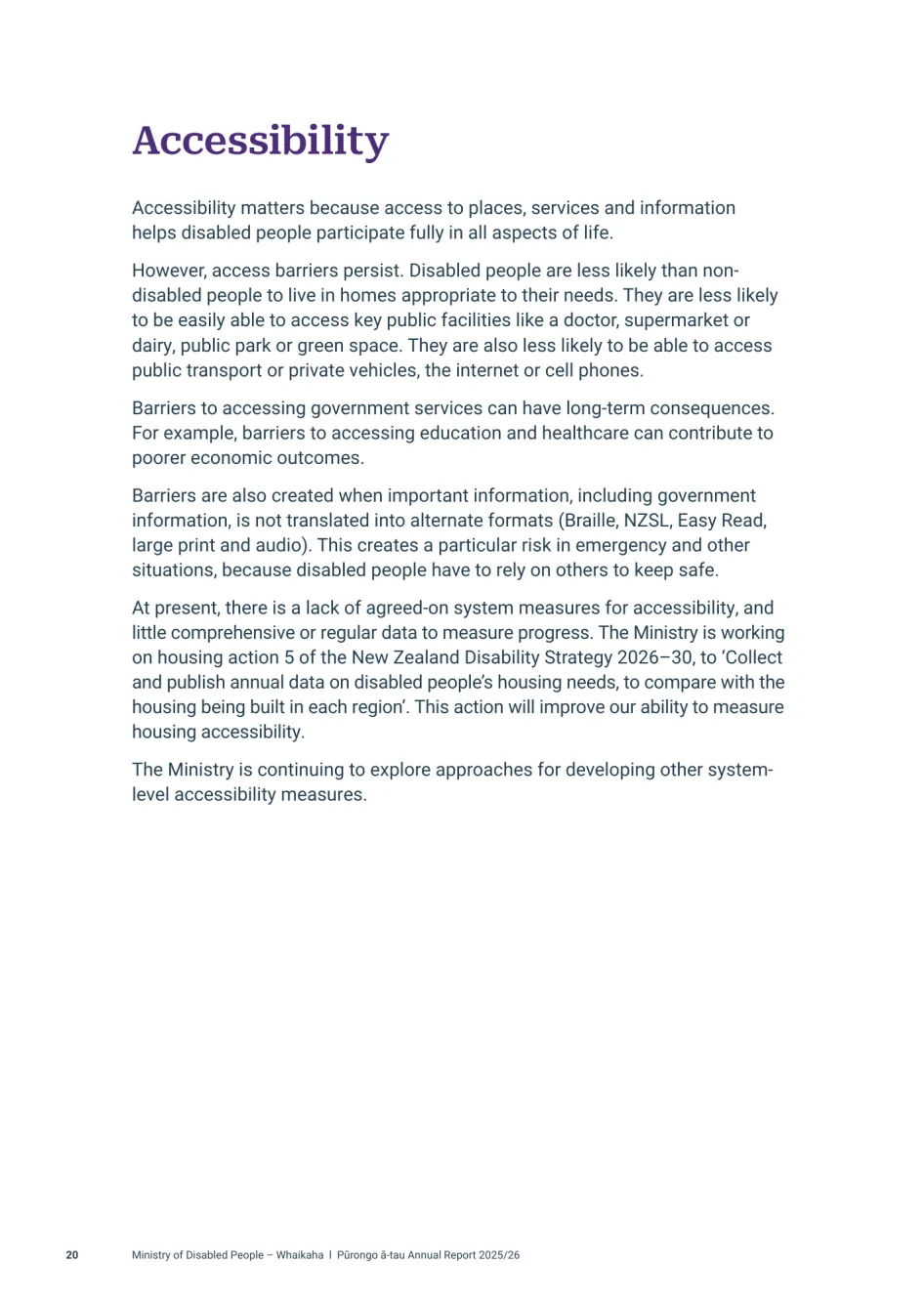
In Whaikaha’s 2024/25 Annual Report (page 19), they promised us that they are working on producing system-level measures for accessibility, and they’d be giving an update in next year’s annual report.
So… me being the menace I am, I checked the next annual report to see if they did what they promised.
Did they do what they promised? No, not really.
One year later, the 2025/26 report (page 20) makes the claim that there is “a lack of agreed-on system measures for accessibility”. There’s no clear description of what this new system-level measure will be.
But… uhh, CWAC exists! Literally in this blog post, right above, is a system-level measure of accessibility produced by the government. Sure, it only covers government agency websites, but it’s fairly “system level”, I would say.
My broader complaint here is this disability ministry was established in 2022 (about 4.5 years ago!), and yet it still has no grasp on measuring accessibility.
You can’t fix something without measuring it, you can’t assess policy efficacy and there are no feedback loops for learning or accountability!
Whaikaha was preceded by the Office for Disability Issues by about 21 years… So arguably, the government has had a dedicated disability policy group for nearly a quarter of a century, and yet in 2026, it’s still too hard to report even a singular measure for accessibility.
I’m unsure how $21 million is spent funding this disability ministry, yet when I scratch the surface to look at their actual results, I see even the most basic system-level tasks have not been completed. A Minister would have no idea if accessibility is being properly managed by the ministry; if it’s improving, or getting worse.
Compare the two annual report pages
A proposed new accessibility standards law
A member’s bill for accessibility was put in the biscuit tin, by NZ First MP Jenny Marcroft.
The bill was surprisingly good, and aligned with what most of us had been campaigning for: basically the establishment of accessibility standards in many areas of life, and a way to enforce them.
The bill has some pretty obvious errors in it, but hopefully they can be resolved.
But, we’re currently in limbo — at the time of writing, the next government is uncertain after the election. Unless the incoming government takes it up as a government bill, we’re relying on a random chance it will be pulled from the biscuit tin.
A new Digital Accessibility Standard is in the works
For many, many years, NZ government agency websites have had to comply with the Web Content Accessibility Guidelines.
But there was an obvious gap — software, apps, emails, etc were not clearly in scope.
This was a huge oversight. It’s hopefully now being corrected by the new Digital Accessibility Standard.
However, as I’ve pointed out, I have some serious concerns about what set of agencies the proposed standard will apply to. It will exclude the health system, ACC, local councils, and the Parliamentary Counsel Office.
The health system having no digital accessibility standards is completely bonkers.
Total Mobility got degraded
Total Mobility is a scheme that gave disabled people a 75% discount on taxi fares, up to a certain limit.
It’s intended to help people who can’t drive, and may struggle with public transport.
In the government’s infinite wisdom, they cut the subsidy from 75% to 65%, because they felt the scheme was getting too expensive to run.
Overall I’m not a huge fan of the Total Mobility scheme for myself — I don’t like taking taxis and much prefer rideshare apps because they have predictable pricing and GPS features.
But, for an entire 3-year term of government, they had the intention to actually improve Total Mobility for disabled people, instead they just made transport more expensive. It just feels… lazy, to me.
NZS 4121:2001 refresh
NZS 4121:2001 is the main standard used for accessible buildings/facilities in NZ.
It’s a seriously crusty standard (from 2001!) so a refresh is long overdue.
Luckily, it appears Standards New Zealand is working on a refreshed version, with an expected publication date some time in 2028.
Plain Language Act
The Plain Language Act is intended to require government agencies to write in plain language that people can understand. This has obvious benefits for many disability types.
The coalition government decided they wanted to get rid of it, so they added a repeal bill on to the parliamentary order paper.
However, this repeal bill just languished far down the order paper’s rankings for months and months, and never got its second reading in Parliament before the house rose for an election.
So, for now, it looks like the Plain Language Act might survive a little longer!
Conclusion
Overall I think it has been a bad year for disabled people.
I haven’t really even scratched the surface of the negative policy changes that have occurred, because this blog post was already getting too long.
I think we have sadly been impacted by brainless anti-DEI politics coming out of America, and certain people in power have felt emboldened to reduce the supports that disabled people need to participate in society and survive.
One of the main things I seem to be expressing in this post, is that there has been a horrible, long-running disconnect between government agencies “looking busy” and actually delivering measurable social change for disabled people. We give these “population group” agencies a lot of money, and I want to see them actually shift the real-life stats like employment.
I think there is a fundamental machinery-of-government problem with “population group” ministries like Whaikaha: they are asked to represent an entire population group’s interests, with literally no power to change anything. Perhaps ministries like Whaikaha will never have the power to make the changes we expect, and we’ll forever be disappointed.
Population group ministries may end up not actually representing the interests of the population group they claim to serve, as they are more focused on delivering the preferences of the government of the day. What if the things that disabled people actually need, are things the current government despises? If disabled people were homeless and in poverty (some literally are right now), do you think Whaikaha would advocate for increased benefit levels while a right-wing government is in power?
If you had to ask me what my one wish is, it would be for the government to actually start addressing the disability employment crisis in a way that makes measurable change. For too long they’ve been chasing their own tail. It’s time to actually solve the problem directly.
Once disabled people have better economic outcomes, many of the negative effects of inaccessibility will simply vanish.
— Callum